How to reduce spam complaints
Spam complaints are one of the primary signals taken into account by email providers such as Gmail, Outlook, or Yahoo.
A complaint occurs when a recipient considers an email to be unsolicited and reports it as spam. Even if your email was sent to someone who initially agreed to receive your communications, a high number of complaints can degrade your sender reputation and, in some cases, affect the deliverability of your future emails.
Let's review the 20 best practices you should follow to protect your email deliverability and reduce the risk of spam complaints.
1. Send only to contacts who expect to receive your emails
The number one cause of a complaint is often simple: the recipient does not expect to receive the email.
Before sending a campaign, ask yourself:
Did the person actually request to receive my emails?
Do they know why they are receiving this email?
Does the content match what they agreed to receive?
Is my identity easily recognizable?
Is it clear how they can unsubscribe?
Example: A person downloads an ebook titled "10 tips to improve your SEO". They agree to receive this ebook, but a few days later, they receive an intensive series of emails selling a trading course.
Even if they technically provided their email address, they may consider these messages unsolicited and report them as spam.
Consent must therefore be consistent with the communications actually sent.
2. Different contact collection scenarios
Not all contact lists present the same level of risk:
a. Voluntary newsletter subscription
The contact voluntarily enters their address to receive your newsletter.
Risk: Low, provided that the emails align with what was promised during subscription.
b. Subscription via a form
The contact fills out a form to get content, attend an event, or receive an offer.
Best practice: Clearly explain on the form that the address will also be used to receive your marketing communications, when applicable.
c. Lead magnet
The contact provides their address to download an ebook, checklist, video, etc.
The risk arises when the address collected to receive specific content is subsequently used to send entirely different marketing communications.
Best practice: Clearly state what the contact will receive after subscribing.
d. Importing an old list
An old list may contain:
Addresses that have become invalid
Contacts who no longer remember subscribing
People who no longer wish to receive your emails
Recycled or abandoned addresses
Contacts who never actually requested your communications
An old list should not be considered healthy simply because it was originally collected legally.
e. Purchased list
Buying lists is a major source of risk.
People on these lists generally did not ask to receive your emails, and some addresses may be used as spam traps to detect abusive senders.
Never use a purchased list for your campaigns.
f. Scraped or harvested list
Harvesting addresses from a website, directory, LinkedIn, social network, or any other source does not mean those people have agreed to receive your emails.
A public email address is not necessarily an opt-in email address.
g. Contacts provided by a third party
For example, an agency, partner, company, or sales team provides you with a list. You must be able to explain:
Who collected the contacts
In what context
How the contacts agreed to receive communications
Which company or person was identified as the sender
Whether this consent actually covers your own communications
Consent given to one company does not automatically mean you can use that list for your own communications.
3. Avoid sudden changes in volume
A sudden change in behavior can be a negative signal for email providers.
Example to avoid: You have a list of 50,000 contacts but haven't sent anything in several months.
You return and immediately send 50,000 emails in a single campaign.
This practice can lead to:
More bounces
More complaints
Significant unsubscribes
Lower engagement rates
Delivery limitations or delays
A degraded domain reputation
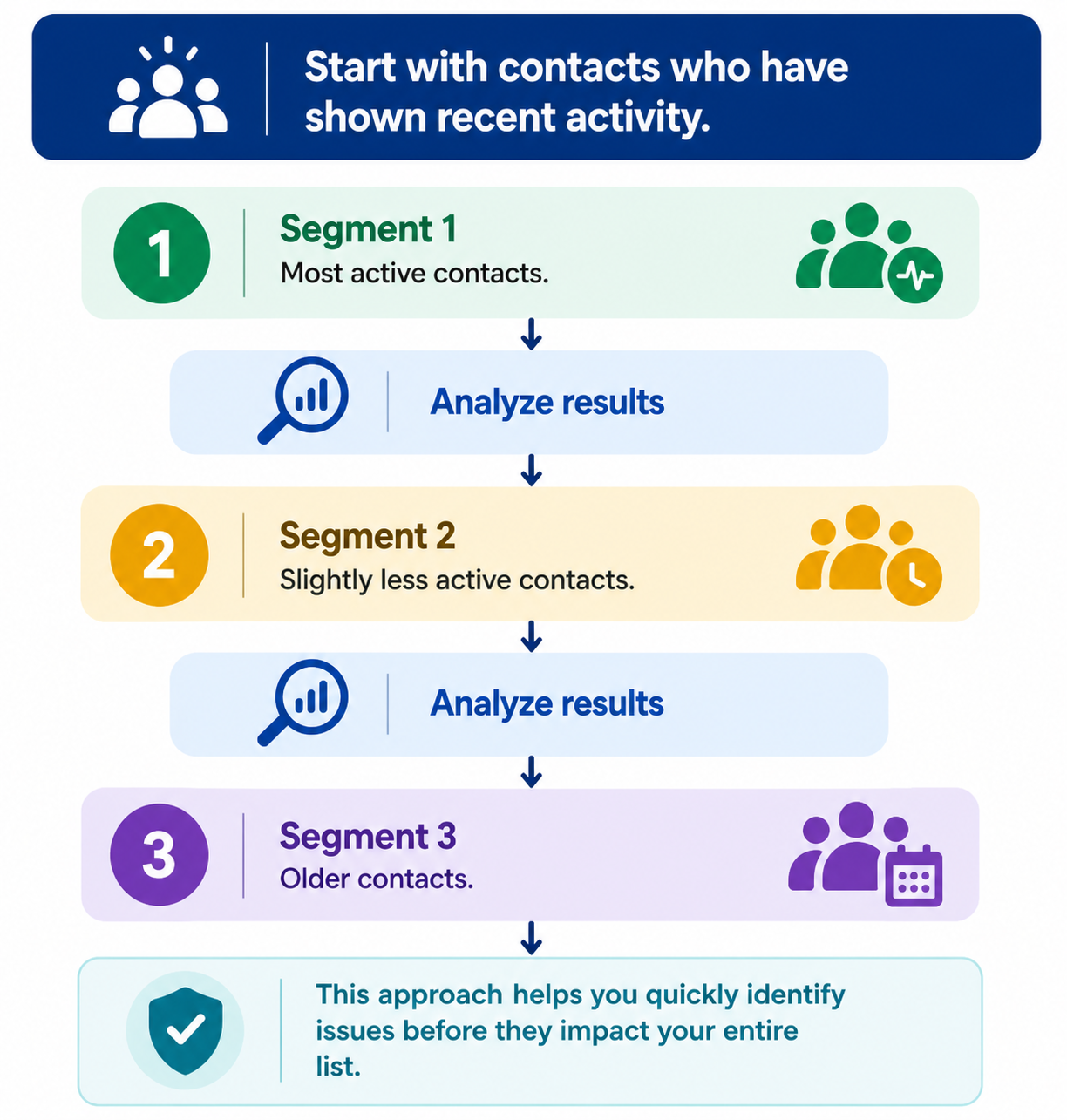
Opt for a gradual resumption, and start with contacts:
Who were most recently active
Who are the most engaged
Who have recently opened or clicked
Whose addresses were collected recently.
Analyze the results before gradually increasing your volume.
4. After a long period of inactivity, do not reactivate your entire list immediately
A list that has been inactive for several months or years must be handled with caution.
During this time:
Some contacts may have changed their address
Some inboxes may have become inactive
Some contacts may have forgotten they subscribed
Recipient expectations may have changed
Your domain may no longer enjoy the same level of engagement
Best practice:
5. Clean your list before sending
A high-quality list contributes directly to better deliverability. Before a major campaign, specifically identify:
Invalid addresses
Historical hard bounces
Unsubscribed contacts
Contacts who have reported your emails as spam
Long-term inactive contacts
Addresses posing a specific risk
You can also use email address validation tools, whether free or paid, to identify certain invalid or high-risk addresses before sending.
However, a list cleaning tool does not turn a bad list into a legitimate list.
It can identify technical issues with addresses, but it cannot determine with certainty whether a person actually consented to receive your communications.
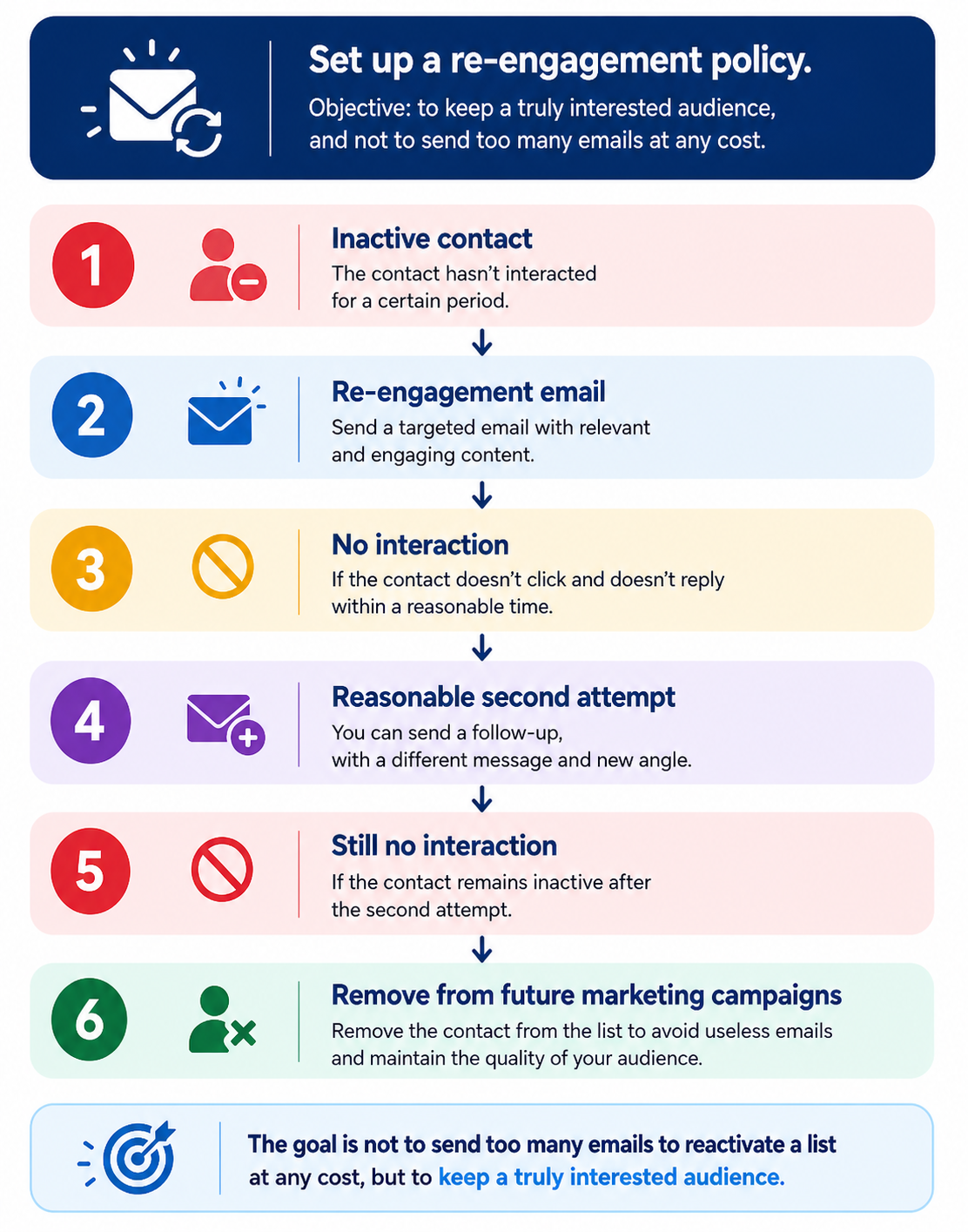
6. Manage inactive contacts
A contact who hasn't opened any emails in several months or years is not necessarily someone you should continue to email indefinitely.
The more completely inactive contacts a list contains, the more likely you are to experience:
Low engagement
More unsubscribes
More complaints
More invalid addresses
Best practice:
7. Respect the expected frequency
Someone who subscribes to a weekly newsletter doesn't necessarily expect to receive five emails a day.
An excessive frequency can lead to:
Numerous unsubscribes
Spam complaints
A drop in engagement
The ideal frequency depends on the context, but above all, it must be predictable and consistent with what was announced at the time of subscription.
8. Avoid sudden changes in frequency
Deliverability issues don't solely stem from high volume. A sudden increase in frequency can also catch recipients off guard.
Example: You send 1 email per week for 6 months, then suddenly you send 3 emails per day for 2 weeks.
Even if the contacts are legitimate, some may consider this change abusive.
A significant increase in frequency must be gradual and justified.
9. Use a clear sender identity
The recipient must immediately be able to understand who is writing to them. Your:
Sender name
Sending address
Domain
Content
Branding
must be consistent.
Avoid frequent changes to your sender name or domain, which could prevent recipients from recognizing you.
10. Make unsubscribing easy
A recipient who no longer wishes to receive your emails must be able to unsubscribe easily. Do not try to prevent or complicate the unsubscribe process.
A clear unsubscribe button or link often turns "I don't want to receive these emails anymore." into "I am unsubscribing." rather than "I am reporting this email as spam."
An unsubscribe is generally preferable to a spam complaint.
11. Respect unsubscribes immediately
When a contact unsubscribes, do not continue sending them marketing campaigns. You must also avoid later re-importing these contacts into a new list without checking their status.
Managing unsubscribes should be considered a core element of your deliverability strategy.
12. Be careful with misleading content and subject lines
Certain subject lines can trigger complaints even when the list is legitimate.
Avoid phrasing that is:
Misleading
Excessively alarmist
Artificially urgent
Giving the impression of a system notification
Imitating bank, administrative, or security communications
Example to avoid: "[ACTION REQUIRED] Your account is about to expire", if the recipient's account is not actually about to expire.
The content of the message must be consistent with its subject line.
13. Avoid excessive clickbait
A subject line promising something that the content fails to deliver can provoke a negative reaction.
Example: "You've won $10,000".
when the email simply explains how to enter a sweepstakes.
The greater the gap between the promise and the content, the higher the risk of a complaint.
14. Segment your audience
Sending the same message to your entire database is not always the best strategy. You can segment your contacts based on:
Their activity
Their purchase history
Their interests
Their subscription date
Their interactions with your emails
The pages or products that interest them
Relevant content targeted at a specific segment will generally be better received than a generic message sent to everyone.
15. Do not systematically send to your entire database
Before each campaign, ask yourself: Does this person really need to receive this email?
If the answer is no, it may be better not to include them in the campaign.
A smaller but engaged database is generally preferable to a very large but inactive one.
16. Pay special attention to sensitive promotions and offers
Certain types of offers can naturally generate more distrust or complaints. Be particularly careful with:
Promises of quick money
Investments
Financial opportunities
Highly aggressive offers
"Miracle" methods
Offers using high-pressure sales tactics
The more an offer can be perceived as deceptive or aggressive, the more important it is to verify the quality of the content, the source of the contacts, and the expectations set during subscription.
17. Do not reuse a list from another business without verifying consent
Changing your:
Product
Company
Domain
Business activity
Brand
can alter contact expectations.
A person who agreed to receive communications from Company A did not necessarily agree to receive them from Company B.
Before migrating any list, verify that their consent fully covers the new usage.
18. Be particularly careful with very old lists
The older a list is, the more you need to ask yourself: Do these people still want to receive my emails?
An address collected several years ago is not automatically a good address to contact today. Several years of inactivity can also increase the risk of:
Hard bounces
Complaints
Unsubscribes
Low engagement
19. Monitor your metrics after each campaign
Don't just look at the number of emails sent. Specifically monitor:
Spam complaint rate
Bounce rate
Hard bounces
Unsubscribe rate
Open rate, when this data is available and interpretable
Click rate
Any errors or limitations from email providers
The goal is to identify a decline before it becomes significant.
20. If complaints increase, stop and analyze
If a campaign suddenly generates many more complaints than usual, avoid continuing to send to your entire database immediately.
Analyze:
The source of the contacts
Their age on your list
Their engagement level
The content sent
The subject line
The sending frequency
The volume sent
Recent changes to your domain or business
It may be better to temporarily pause problematic segments rather than continuing to send and worsening the situation.
Paying special attention to major email providers: Each email provider has its own filtering mechanisms.
A bad experience with one provider can result in:
More messages placed in spam
Delays
Temporary blocks
An increase in delivery errors
It is therefore important to monitor trends by provider when the data is available.
The importance of traffic quality on shared IPs:
On an infrastructure using shared IPs, multiple users may send from the same sending architecture. This means that the reputation of the infrastructure depends largely on overall traffic quality.
For this reason, the following behaviors are particularly problematic:
Purchased lists
Scraped lists
Sudden massive volumes
Campaigns sent to very old contacts
High complaint rates
High hard bounce rates
Misleading content
Practices comparable to spam.
The best way to protect your deliverability is therefore to maintain a healthy list and send only to recipients who are actually expecting your communications.
Mistakes to absolutely avoid:
Practice | Risk Level |
|---|---|
Buying a list | Very High |
Scraping addresses | Very High |
Sending to an old list without preparation | High |
Sending immediately to an entire list after a long break | High |
Abruptly increasing volume | High |
Abruptly increasing frequency | High |
Sending to contacts inactive for several years | High |
Using misleading subject lines | High |
Hiding the unsubscribe option | High |
Ignoring complaints | Very High |
Continuing to send after a sharp decline | Very High |
Segmenting contacts | Recommended |
Regularly cleaning your list | Recommended |
Using double opt-in when appropriate | Recommended |
Gradually re-engaging contacts | Recommended |
Monitoring metrics | Recommended |
The golden rule: Before each campaign, ask yourself these five questions:
1. Why is this person receiving my email?
2. Do they really expect to receive this type of message?
3. Does my content match what they agreed to receive?
4. Are they still active and interested?
5. Can they easily stop receiving my communications?
If you cannot clearly answer these questions, it is best not to send the campaign to this contact until the situation is clarified.
Good deliverability does not solely rely on your domain's technical configuration or sending infrastructure.
Above all, it depends on the quality of the relationship between the sender and their recipients.
The best way to reduce spam complaints is to send relevant emails to contacts who actually requested to receive them, at the time and frequency they expect.
Last updated on October 27, 2026